Governance built in from the very first word.
GAIA doesn’t scan content once it’s written. Your standards shape each piece as it’s created, anything that falls short is held back, and how it was made is recorded.
How a piece moves through GAIA.
Your eight areas of governance are set up once. Every piece then follows the same route, from who it’s for to the record that proves how it was made.
Who it’s for
- Content type
- Persona and modifiers
What it says
- Intent and topic
- Originality
- Angle
- Keywords and structure
The draft
- Written inside your rules
- Claims tied to evidence
- AI tells removed
Pass or hold
- Every area checked
- Findings tied to passages
- Override needs a reason
Ready to use
- Related images
- Schema
The proof
- Rules and versions
- Checks and decisions
- Hash-chained record
Each step is locked before the next begins, so nothing upstream can quietly change once the piece is under way.
Every choice is locked in turn.
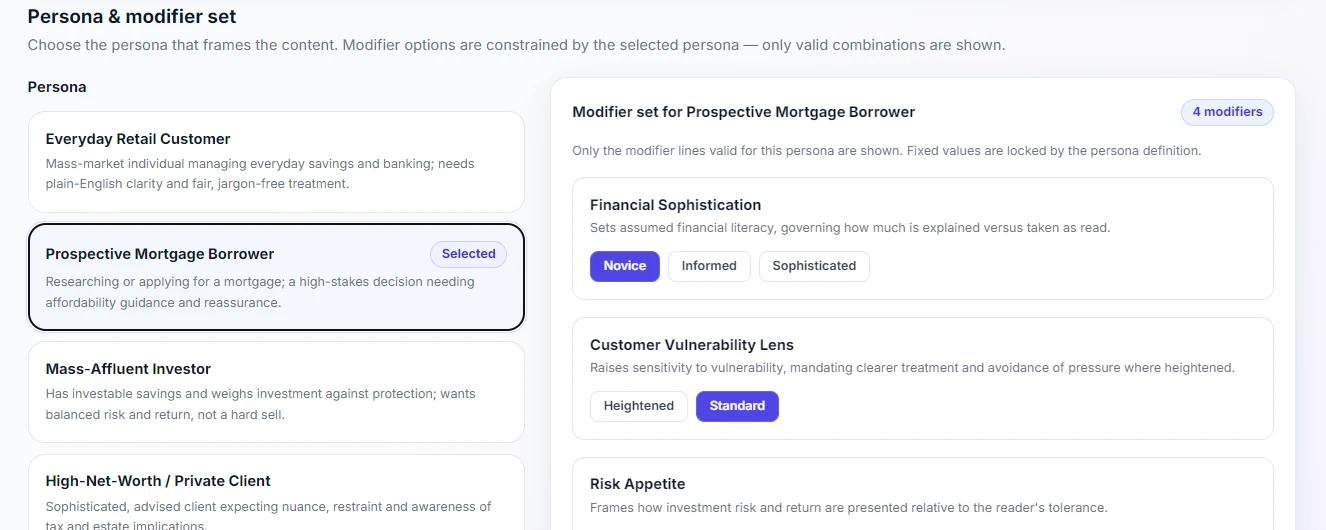
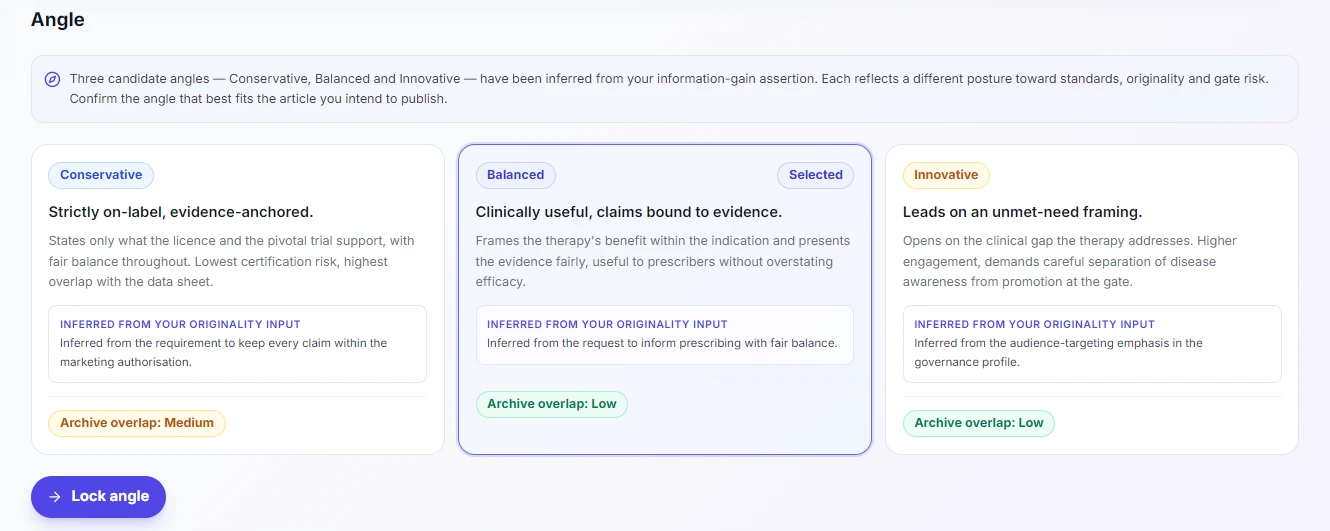
You choose who the piece is for, and GAIA offers only the options that make sense for that reader. The angle is shaped by what’s genuinely new in your piece and checked against what you’ve already published.
 Click to enlarge
 Click to enlarge
Checks run while the piece is written.
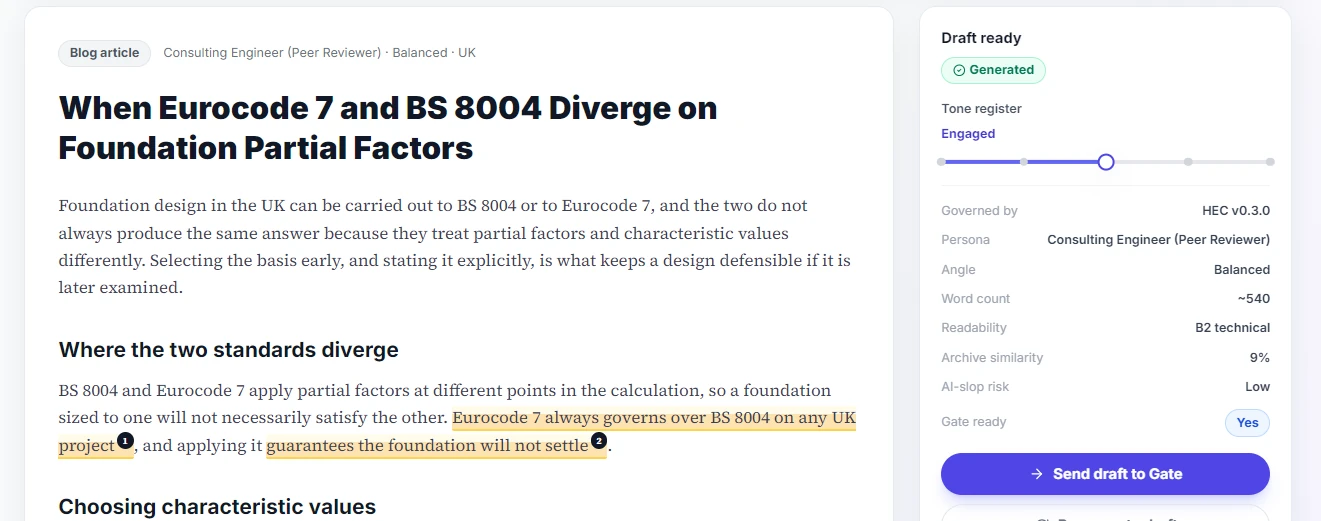
As the draft takes shape, GAIA tracks readability, similarity to your archive and the risk of generic AI phrasing. Claims that go further than your evidence are marked in place, so they can be fixed before the gate ever sees them.
 Click to enlarge
Anything that falls short waits at the gate.
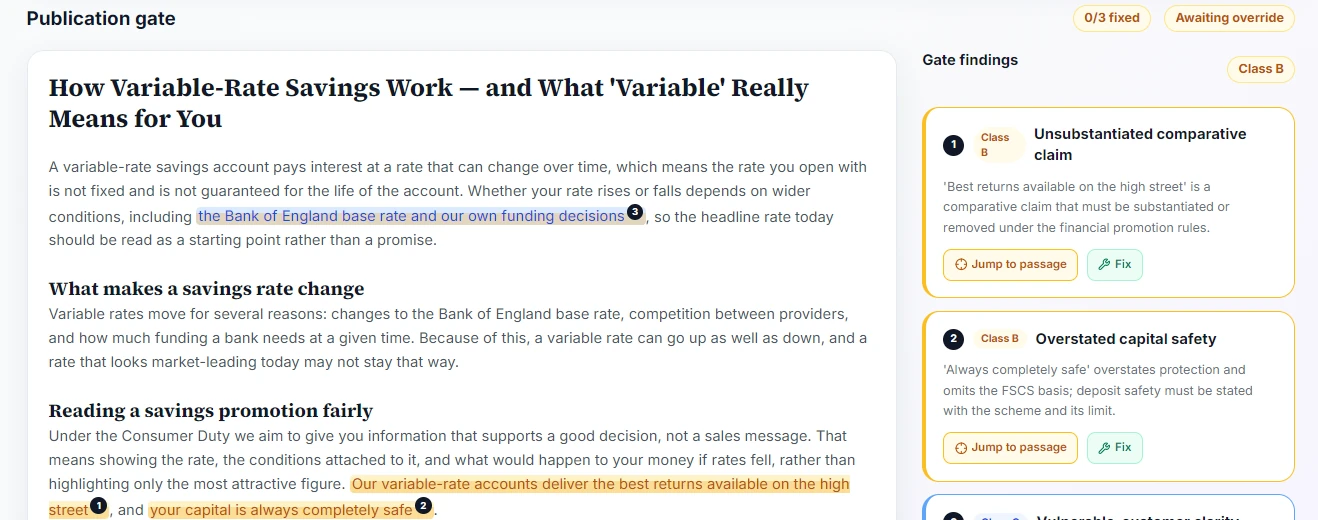
Content that doesn’t meet your standard is held at the gate until it does, or until a person releases it with a recorded reason. Nothing reaches “approved” without clearing the checks or leaving a trace of who decided otherwise, and why.
 Click to enlarge
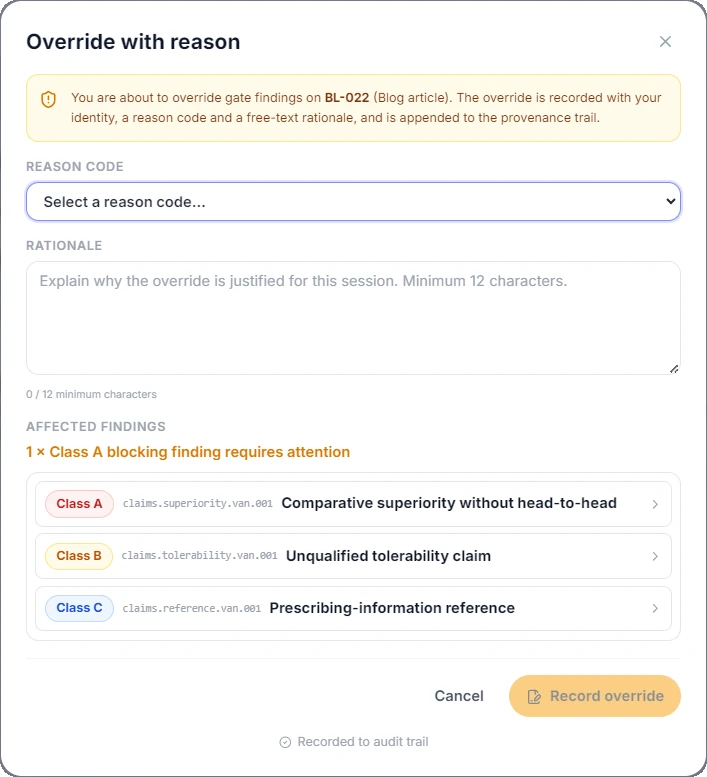
A person can always overrule it, on the record.
Sometimes a finding is right to set aside. When it is, the person releasing the piece chooses a reason code and writes a short rationale. Both are added to the audit trail with their name, so every exception can be explained later.
 Click to enlarge
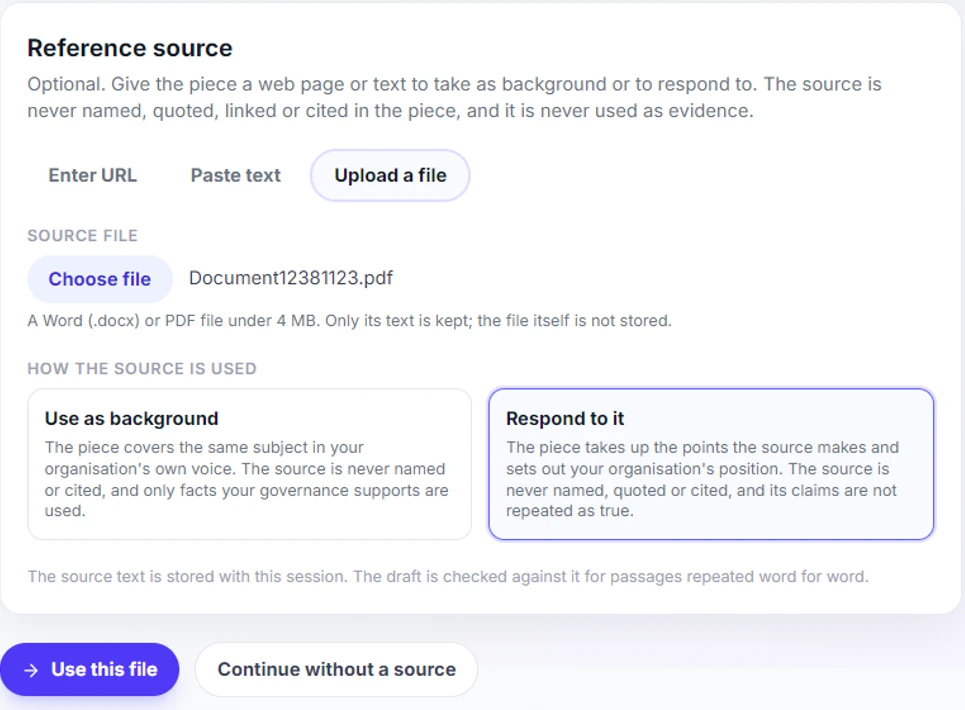
Bring a source. Keep it at arm’s length.
You can give GAIA a web page or document to work from. It’s used as background or as something to respond to, never quoted or treated as evidence, and the draft is checked against it for anything repeated word for word.
 Click to enlarge
Proof of how every piece was made.
Every approved piece keeps its findings, decisions and rule versions, linked by a chain of cryptographic hashes. It stays with the piece in your archive long after the session that made it.
More on provenance →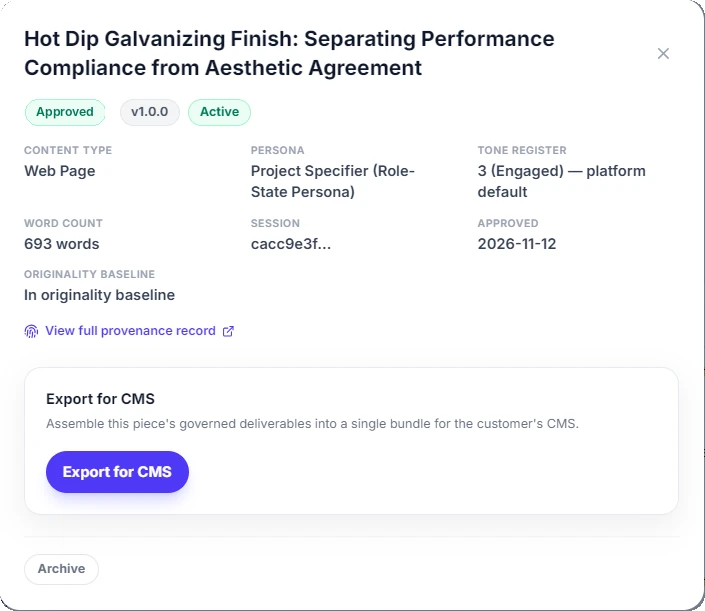 Click to enlarge
Set up with you, then tested before you rely on it.
GAIA isn’t a blank tool you configure alone. We run a structured intake and hand you a governance configuration that’s been built and tested against your own material.
Discovery
A structured questionnaire and your source material: what you publish, the standards it’s held to and the claims you can make.
Configuration
We write your governance rules across all eight areas: your voice, your claims framework, your standards.
Testing
The configuration is run against your own content and tuned until it holds.
Calibration
We review it with you, then lock the version so you know exactly which rules are in force.
Typically two to four weeks, depending on how complex your standards are.
See it working on your kind of content.
Tell us what you publish and what it costs when it’s wrong, and we’ll walk you through how GAIA would govern it.
Book a walkthrough