Provenance, built in from the start.
Being open about how AI content was made is fast becoming an obligation. GAIA records it for every piece as standard.
The rules have caught up with the volume.
The EU AI Act’s transparency rules are now in force. They expect AI-generated content to be identifiable, including machine-readable marking by the providers of generative AI systems. Content Credentials, from the open C2PA standard, are the most widely adopted way to carry that information, and are being standardised internationally as ISO 22144, currently at draft stage.
Article 50 applies
The EU AI Act’s transparency obligations for AI-generated content take effect.
Grace period ends
Generative AI systems already on the market before August must have their marking in place.
GAIA records provenance
Every piece carries a structured record of how it was made, kept with it in your archive.
A chain from your rules to the finished piece.
Each link is recorded and fingerprinted, and each record is chained to the one before, so the history of a piece can’t be quietly rewritten.
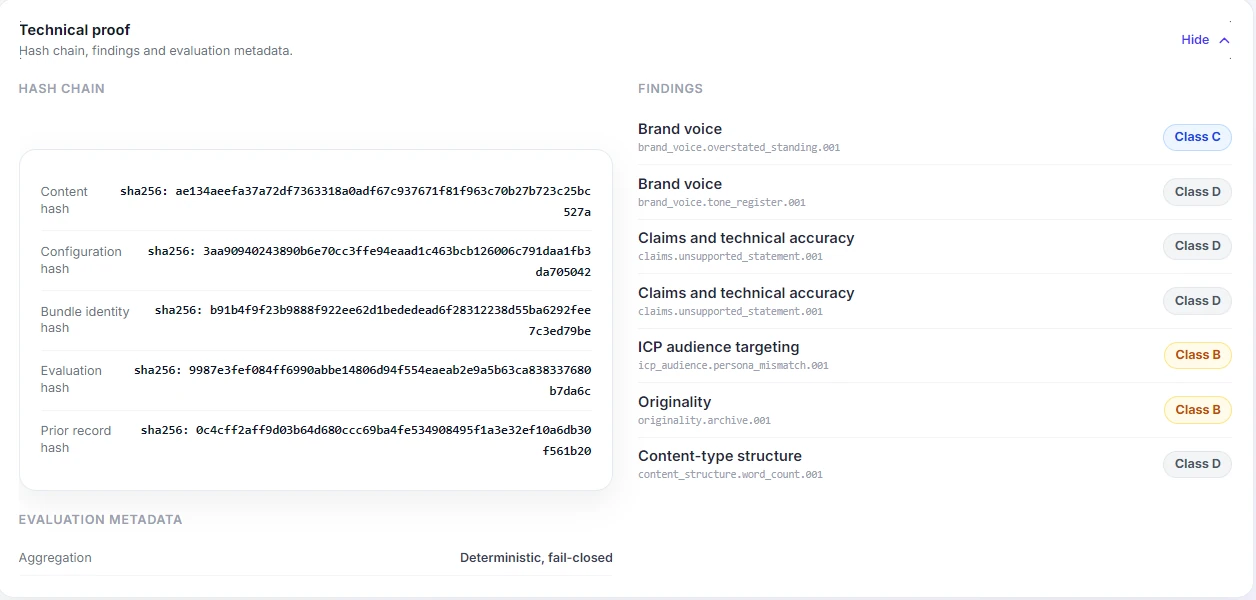 Click to enlarge
What ships today, and what’s coming.
A provenance record for every piece. Rules, versions, checks, decisions and overrides, linked by a chain of cryptographic hashes and kept with the piece.
Full C2PA Content Credentials, so a piece’s history can be verified independently of GAIA. We’ll announce it when it ships, not before.
What this is, and what it isn’t.
GAIA is the governance and evidence layer for your content. It isn’t legal advice, and it doesn’t certify that your content meets any regulation. That judgement stays with your experts. What GAIA gives them is the record that makes the case.
Talk it through with us.
We’ll show you what GAIA records, and where the line sits between what we enforce and what your experts decide.
Book a walkthrough